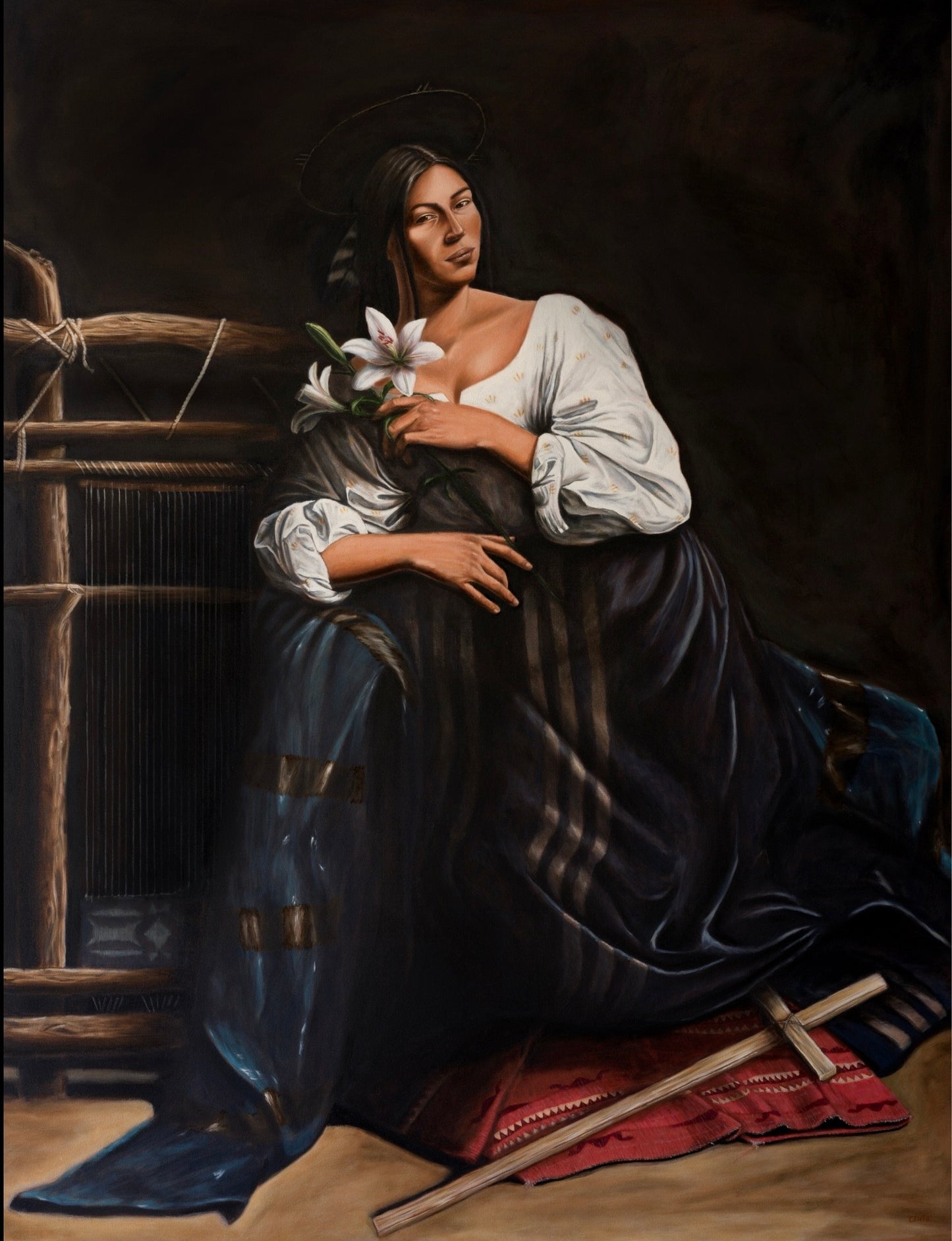
Saint Catherine - Lily of the Mohawk
Saint Catherine - Lily of the Mohawk
52”x68” Oil on Canvas
Inspired by Caravaggios St. Catherine of Alexandria
Today, Michelangelo Merisi da Caravaggio’s painting of St. Catherine of Alexandria is held at the Thyssen-Bornemisza Museum in Madrid. In my view, this is an underrated work by Caravaggio. At 68” x 52”, it’s an appropriate size for a piece like this—it comes right at you. Once you know the history of exactly who St. Catherine was, the painting becomes tragic but also empowering. My first questions upon seeing it were: Why the wheel? And what did she do to receive that halo?
St. Catherine was a princess, the daughter of a governor in the Roman Empire, in Alexandria, Egypt. This was before the time of Constantine. The Roman Empire was still a pagan regime and had been persecuting Christians for centuries. At about fourteen, she had a vision of the Virgin Mary and Jesus. She committed her life to Christianity and to virginity, refusing to marry despite pressure from those around her. The emperor even hired Roman philosophers to debate her beliefs, and Catherine reportedly won. In reaction, she was sentenced to death on a spiked wheel. She did not break. When she approached it and touched the wheel, it shattered. She was later tragically beheaded at about seventeen or eighteen. Before her death, she had converted hundreds to Christianity, earning her the halo and the status of saint.
In Old Town Santa Fe, in front of the Catholic Church—the Cathedral Basilica of St. Francis of Assisi—there is a striking statue of a Native American woman. I thought that was interesting. Catholicism and Native Americans are not generally thought of together. And if they are, most people think of the brutal history of Indian schools, where conversions were forced or Native people were treated horribly by very brutal nuns. But this Native American woman, Tekakwitha, held the status of saint. That seems like a big deal! As it turns out, she was born into the Mohawk Tribe in what is now upstate New York. Like Catherine, she was technically a princess—the daughter of a chief. Her family had all succumbed to smallpox, leaving her the sole survivor, and she was later adopted by others in the tribe. At a young age she came into contact with French Jesuits and fully committed herself to Christianity. In her case, it was not forced; in fact, like Catherine, her own tribe frowned upon it. She was called the “Lily of the Mohawks” for her deep affinity to the flower. Encouraged to marry within the tribe, she refused on multiple occasions, just as Catherine had. She too died young—at twenty-three or twenty-four—from a lingering illness. At the moment of her death, it’s said the damage from her illness vanished from her body, and she became beautiful.
Like Saint Catherine of Alexandria, there are many depictions of Tekakwitha (who was baptized with the name Catherine—making their shared name even more striking). However, as far as I know, I haven’t seen an artist draw the comparison between the two. Two saints with shockingly similar stories—and the same name! It was almost too perfect. Almost like a grand design I was meant to stumble upon.
In this painting, I take Caravaggio’s depiction of St. Catherine of Alexandria and place St. Kateri Tekakwitha directly in her place. The sword becomes lilies, the palm branch becomes a cross, the wheel becomes a loom — appropriate for the many textiles surrounding her and her reputation for the things she could create with her hands — and the gown gives way to Native American blankets and robes. The result maintains the original’s elegance and dramatic power, but now features a comparable figure from history — another Catherine, another saint, living on another continent more than 1,300 years later.
Share